

AML/CFT update – part two
The second and final part of our review of the Institute’s latest AML/CFT conference looks at how evolving international standards, new technologies and increasingly complex business structures are reshaping AML/CFT compliance in Hong Kong.
Highlights
- as international AML/CFT standards continue to evolve, the regulatory focus in Hong Kong is shifting towards areas of partial compliance, such as beneficial ownership, enhanced due diligence and trust transparency
- AI, machine learning and blockchain are transforming transaction monitoring, helping firms reduce false positives while simultaneously introducing new governance and control challenges
- for investment funds, growing regulatory scrutiny and cross-border complexity are reinforcing the need for robust ongoing due diligence, technologically enabled monitoring and clear accountability
The second session of the Institute’s anti–money laundering and counter–financing of terrorism (AML/CFT) conference explored Hong Kong’s evolving compliance landscape, the growing role of artificial intelligence (AI) and data analytics in transaction monitoring, and the practical implications for fund managers facing increasingly complex regulatory expectations.
Going international
Mohan Datwani FCG HKFCG(PE), Institute Deputy Chief Executive, opened the session with a review of Hong Kong’s performance under the Financial Action Task Force (FATF) frameworks, emphasising that compliance is a moving target rather than a fixed destination.
Referring to the FATF Mutual Evaluation Report published in September 2019, Mr Datwani noted that Hong Kong was commended for having ‘a strong legal foundation and an effective system for combating money laundering and terrorist financing’, particularly in areas such as law enforcement, asset recovery and international cooperation. He pointed out that Hong Kong was the first jurisdiction in the Asia-Pacific region to achieve an overall ‘compliant and effective’ rating under the evaluation methodology used at that time.
However, he cautioned that global standards continue to evolve. ‘What we have been doing last year might not be exactly what we need to be doing going forward, because the goalposts do move,’ he said.
Mr Datwani drew particular attention to areas assessed as ‘partially compliant’, clarifying that these are where regulatory scrutiny and supervisory focus are most likely to fall. Using Recommendation 12 on politically exposed persons (PEPs) as an example, he explained that Hong Kong’s treatment of PEPs from the Chinese mainland had previously diverged from FATF expectations, prompting subsequent legislative amendments.
‘Regulators in Hong Kong ultimately have to answer to international standards and these partially compliant areas are strong indicators of what inspectors will focus on in their investigations,’ he said.
He also pinpointed continuing FATF concerns around enhanced due diligence, beneficial ownership transparency, and the treatment of trusts and legal arrangements under Recommendations 22, 24 and 25. In particular, he observed that evolving expectations on trust transparency and beneficial ownership disclosure could foreshadow further reforms.
‘What was acceptable before may not be acceptable going forward – and that is why firms have to stay ahead rather than simply reacting,’ Mr Datwani said.
“What was acceptable before may not be acceptable going forward – and that is why firms have to stay ahead rather than simply reacting.”
Mohan Datwani FCG HKFCG(PE)
Institute Deputy Chief Executive
Using AI, machine learning and blockchain in transaction monitoring
Utpal Patel, Partner, Financial Services Risk Consulting, Ernst & Young Advisory Services Ltd, examined how technology is reshaping transaction monitoring and financial crime controls against a backdrop of rising regulatory pressure and increasing criminal sophistication.
‘Transaction monitoring is the continuous review of financial transactions to detect patterns that may indicate money laundering, terrorist financing or other financial crimes,’ he said, noting that most systems operate on a post-transaction basis rather than in real time.
‘One of the biggest challenges in transaction monitoring is that around 95% of alerts generated by monitoring systems are false positives,’ he said. ‘That means teams spend the majority of their time clearing alerts that are not, in fact, suspicious.’
Mr Patel flagged up that AI and machine learning are increasingly being deployed to address this inefficiency, particularly through tools that triage alerts and prioritise those most likely to warrant investigation. ‘We are seeing AI-driven disposition models that can significantly reduce false positives and allow human investigators to focus on the alerts that really matter,’ he said.
He stressed, however, that current regulatory expectations still require a human in the loop, particularly for decision-making and regulatory reporting. ‘We are not at a point where machines are making end-to-end decisions on suspicious activity reporting – explainability and control remain critical,’ he said.
Beyond alert generation, Mr Patel described how generative AI is being used to support investigations, including automatically drafting investigation narratives and suspicious transaction reports. ‘In many investigations, around 70% of the effort is still manual copying and collating of information,’ he noted. ‘AI can streamline that process so investigators can focus on judgement rather than administration.’
Mr Patel also discussed emerging use cases for blockchain technology, particularly for secure data sharing across institutions. ‘Imagine performing KYC once and sharing that data as a single source of truth across jurisdictions, rather than repeating the same checks multiple times,’ he said.
Concluding his presentation, Mr Patel reminded participants that technology can also amplify financial crime risks if misused. ‘AI does not only help us, it also helps criminals,’ he said, pointing to deepfakes and large-scale scam generation as growing threats.
“We are seeing AI-driven disposition models that can significantly reduce false positives and allow human investigators to focus on the alerts that really matter.”
Utpal Patel
Partner, Financial Services Risk Consulting, Ernst & Young Advisory Services Ltd
AML/CFT compliance challenges for fund structures
Daisy Chan, Director of Fund Services, Vistra, focused on the practical AML/CFT implications for investment funds, drawing on recent regulatory developments in both Hong Kong and overseas markets.
Ms Chan emphasised that AML/CFT requirements are not simply a regulatory obligation, but a core control mechanism. ‘These measures are critical not only for protecting companies and investors, but also for managing increasingly complex operational and regulatory challenges,’ she said.
Ms Chan outlined the key regulatory developments affecting funds, including enhanced due diligence expectations for PEPs and high-risk investors, expanded coverage of virtual asset service providers and stronger enforcement under proceeds-of-crime regimes in multiple jurisdictions. She noted that in some jurisdictions, filing a suspicious activity report alone does not provide a defence, while explicit consent from authorities may be required before transactions can proceed.
Turning to Hong Kong, she highlighted the regulatory expectations around real-time transaction monitoring, the use of automated screening tools and increasing encouragement for AI-driven solutions to improve efficiency and compliance outcomes.
At an operational level, Ms Chan walked through practical investor due diligence processes, stressing the importance of identifying beneficial owners within complex fund structures. ‘For the entities considered as beneficial owners of private equity funds, regulators will look through the structure to the individuals who ultimately exercise ownership or control,’ she said.
She also spelled out the importance of ongoing monitoring throughout the investor lifecycle. ‘AML/CFT is not just about onboarding – risk profiles need to be reviewed periodically, transactions monitored continuously and records maintained to support audits and regulatory inquiries,’ she said.
Ms Chan acknowledged the resource demands of AML/CFT compliance, noting that some funds may consider outsourcing certain AML/CFT functions. ‘While outsourcing can improve efficiency and access to expertise, the ultimate responsibility and liability always remain with the fund,’ she concluded.
“AML/CFT is not just about onboarding – risk profiles need to be reviewed periodically, transactions monitored continuously and records maintained to support audits and regulatory inquiries.”
Daisy Chan
Director of Fund Services, Vistra
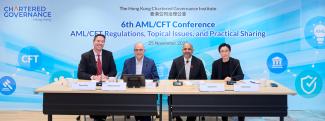
The Institute’s 6th AML/CFT Conference was held on 25 November 2025 in hybrid mode. More information is available on the Institute’s website: www.hkcgi.org.hk.
Credits
The Institute would like to thank everyone who contributed to its 6th AML/CFT Conference. In addition to the speakers quoted in this and the previous cover story in this month’s edition of CGj, the Institute would like to thank the members and practitioners named below (in order of appearance) for their contributions to the debate.
Welcoming Address
Edmond Chiu FCG HKFCG(PE), Institute Council member, and Head of Company Secretarial Services, Greater China, Vistra
Guest of Honour
Joseph HL Chan JP, Under Secretary for Financial Services and the Treasury, the HKSAR Government
Session One Chair
Wendy Ho FCG HKFCG(PE), Institute Council member and Chairman of the Professional Development Committee, and Executive Director, Corporate Services, Vistra
Session One Panellists
Dr Maurice Ngai FCG HKFCG(PE), Institute Past President and Vice- Chairman of the Professional Services Panel, and Director and Group CEO, SWCS Corporate Services Group (Hong Kong) Ltd
Alberta Sie FCG HKFCG(PE), Director and Company Secretary, Reanda EFA Secretarial Ltd
Session Two Chair
Mohan Datwani FCG HKFCG(PE), Institute Deputy Chief Executive
Session Two Panellist
Donald Day, Chief Operating Officer, VDX, and Adjunct Professor, The Chinese University of Hong Kong