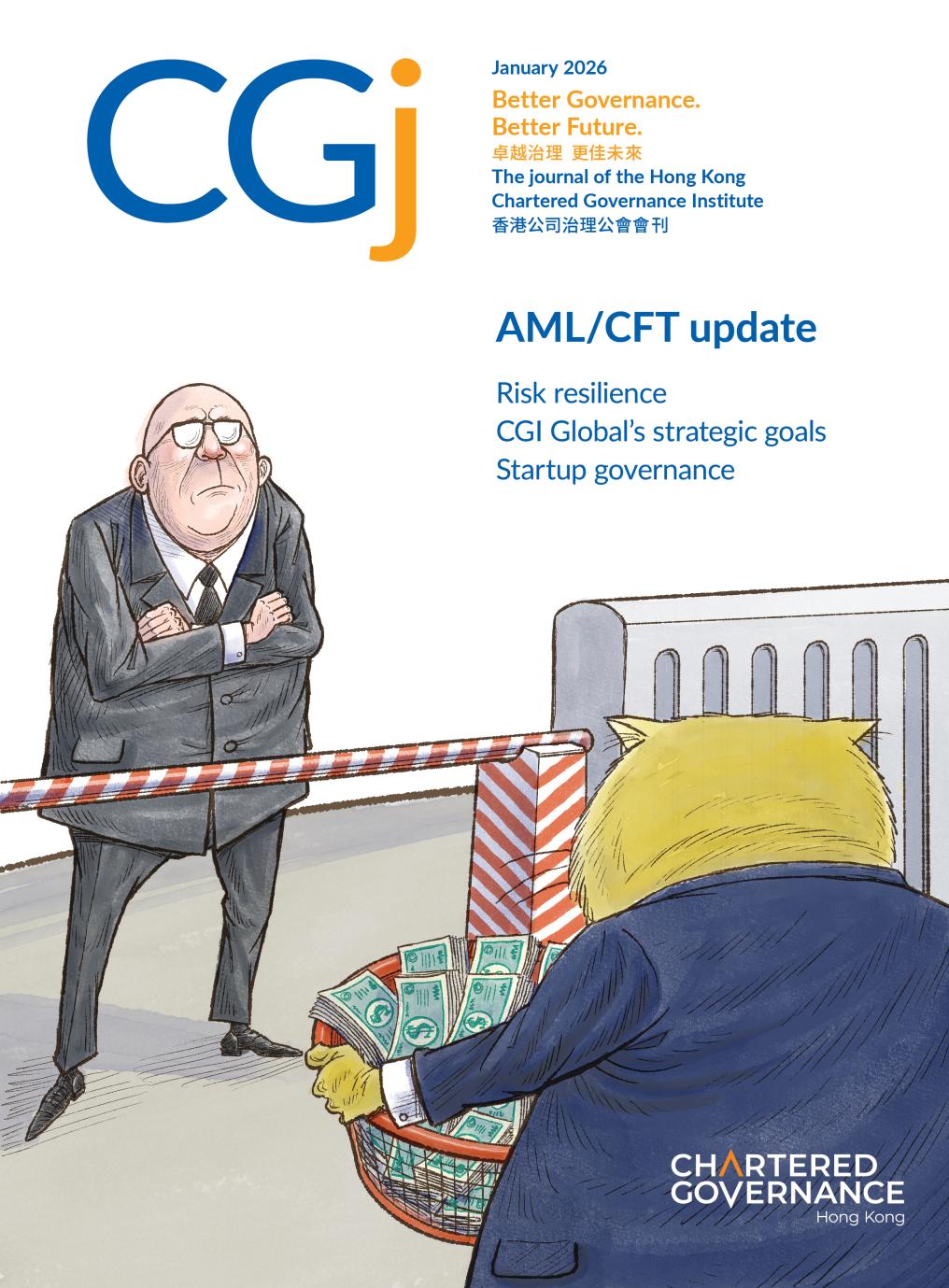



Redefining global governance: CGI’s role in a world under strain
Kerrie Waring FCG, Director General of The Chartered Governance Institute (CGI), talks to CGj about her own path to governance, the enduring principles underpinning effective board oversight for corporate success and resilience, and how CGI is repositioning itself and its flagship qualification programme to support governance professionals in a more demanding world.
Highlights
- as boards worldwide face increasing pressure amid geopolitical tensions, technological disruption, sustainability scrutiny and intensifying regulatory demands, CGI is stepping up its efforts to support and strengthen board governance and effectiveness
- with companies under growing pressure to disclose more, the focus must shift from adding rules to ensuring governance principles genuinely work in practice
- CGI is repositioning the governance profession through modernising its global professional qualification programme and by raising awareness of the value of the profession with key stakeholders to foster a stronger sense of professional identity on a worldwide basis
When Kerrie Waring took up the role of Director General of CGI, the Institute’s global body, in December 2024, she took a seat at the centre of a profession grappling with accelerating complexity. Boards worldwide are being required to navigate geopolitical instability, technological disruption, sustainability scrutiny and intensifying regulatory demands. Yet, amid the noise, Ms Waring is clear-eyed about what has not changed.
‘At its heart, governance is a system of policies and processes that facilitate accountability, responsibility and transparency, thereby enabling efficient and effective decisionmaking in the long-term best interests of an organisation,’ she explains. Company secretaries are the epicentre of that system, discretely advising, facilitating and communicating good governance practices, as well as aligning the interests of the board, management, shareholders and stakeholders in pursuing an organisation’s long-term success and resilience.
‘The challenge today is not that governance is broken, but that it is being tested under extraordinary pressure,’ she contends. ‘We need to concentrate our efforts on supporting boards to enable them to deal with this pressure and to be as effective as possible.’ Company secretaries, as trusted governance advisors, provide a safety net for boards, ensuring that decisionmaking is in the best interests of the organisation.
She firmly believes that in the context of the current pushback against regulatory burdens and complexity, effective governance across jurisdictions depends not on more rules, but on stronger market-led initiatives that encourage meaningful disclosure, stronger shareholder rights and clearer board accountability to shareholders and stakeholders.
With more than 25 years in corporate governance, including 10 years as CEO of the International Corporate Governance Network (ICGN), Ms Waring brings a rare global perspective shaped by boardrooms, capital markets and policymakers alike. Her focus is firmly forward-looking – clarifying core governance principles and the crucial role of governance professionals in supporting boards to meet the demands of today’s challenging business environment.
A global vantage point
Ms Waring’s career has unfolded alongside the globalisation of corporate governance itself. After a stint working in international relations in Hiroshima through the Japan Exchange and Teaching Programme in the late 1990s, she entered the governance field through the UK’s Institute of Directors (IoD) at a time when many markets were still building their basic governance infrastructures.
‘I joined the IoD in 2000 and very soon after that we worked on a mandate from the Global Corporate Governance Forum,’ she recalls. Established by the World Bank and the Organisation for Economic Co-operation and Development (OECD), the Forum’s mission was to help markets develop governance frameworks at a time when the concept was still ‘very embryonic’.
Ms Waring’s task was to develop a toolkit to help establish institutes of directors around the world – practical guidance on how to build a professional governance body with a remit to educate and share knowledge of good governance practices. The work gave her a front-row seat to what she describes as a methodical rollout of corporate governance around the world.
‘The G20/OECD Principles of Corporate Governance were – and remain – the North Star,’ she notes. ‘The World Bank produced its Reports on the Observance of Standards and Codes to address national governance infrastructures, aligned with the OECD Principles, and then make recommendations on how to introduce or strengthen governance infrastructures, for example through the establishment of codes, institutes of directors or governance associations and training programmes. The Forum came in to support that process.’
This was a formative period for Ms Waring, one that revealed both the universality and the adaptability of governance principles. From there, her roles at the Institute of Chartered Accountants in England and Wales, and later the ICGN, exposed her to governance from multiple angles – directors, auditors and long-term institutional investors. Her current role at CGI brings her back home to her own profession as a Chartered Company Secretary.
‘My experience working across market sectors has given me an all-round insight into how corporate governance is applied, assured and valued across jurisdictions’, she recounts. That holistic, international lens continues to inform her thinking today, particularly as governance norms face political and practical pushback.
What governance is really for
The world of governance has evolved significantly from the early 1990s, Ms Waring observes, not just in scale but in expectation. What began as a framework focused largely on the financial aspects of corporate governance, as well as basic accountability and board structures, has expanded into a far more demanding discipline, shaped by global capital flows, sustainability risks (and opportunities), technological disruption and heightened public scrutiny of the purpose and conduct of companies.
‘The role of the board today is to preserve and enhance long-term corporate value,’ Ms Waring asserts. ‘Not just value in the narrow sense of shareholder returns, but longterm value taking into account sustainability-related risks and opportunities relevant to all key stakeholders.’
This shift – from pure shareholder primacy to an enlightened shareholder value model – recognises that corporate success depends on its relationship with wider society. ‘The purpose of companies isn’t just to generate returns, but is to create successful, resilient organisations that contribute to sustainable economies and societies,’ Ms Waring points out.
That doesn’t mean, however, that shareholders have been downgraded. If anything, Ms Waring argues, their role has become more central, particularly as stewards of capital. ‘Shareholders are still the primary stakeholder group with the authority and influence to properly hold companies to account for their governance and performance,’ she specifies. ‘Investors are corporate allies, not enemies. They share a common objective with boards and management to preserve and enhance long-term corporate value for their underlying beneficiaries.’
This belief underpins her defence of the complementary system that has emerged over the past two decades – corporate governance codes on one side and investor stewardship codes on the other.
‘They sit like a yin and yang,’ she explains. ‘Companies disclose how they apply – or don’t apply – governance code principles, while investors are expected to monitor these disclosures and hold companies to account through voting at general meetings and through company engagement.’
Shareholder model under pressure
One of the most prominent debates in governance today centres on whether the traditional shareholderbased accountability model is losing relevance, especially amid political backlash against sustainability initiatives.
Ms Waring is sceptical of claims that the model itself is under threat. ‘I don’t think the core idea – that good governance contributes to successful, resilient companies – is under attack,’ she says. ‘What’s being challenged is the degree to which companies are held accountable for their impacts on society and the environment – otherwise known as sustainability issues. She adds that ‘sustainability is not just restricted to environmental, social and governance matters – it also extends to finance, economics, digitalisation, political stability and more’.
Ms Waring traces much of the current unease to reporting fatigue, rather than being an outright rejection of the importance of sustainability. She points to investor support for the work of the International Sustainability Standards Board (ISSB) as a necessary attempt to create global consistency and comparability of corporate sustainability reporting, including information on governance, strategy, risk management and targets. At the same time, Europe’s embrace of double materiality under the European Sustainability Reporting Standards (ESRS) has similar aims, but with an enhanced emphasis not only on the sustainability impacts on the company, but the impact of the company itself on society and the environment.
Going forward, Ms Waring believes we are likely to see more corporate reporting simplification aimed at cutting burden, complexity and cost. Sustainability discussion will continue to evolve and is now turning to nature-related financial disclosures. Rules will continue to develop, with recent examples being in relation to greenwashing, AI governance and human rights violations.
‘The pushback we’re seeing is not against sustainability per se, but against the sheer volume and pace of reporting requirements,’ she suggests. ‘Companies – particularly those with cross-jurisdictional listings – are struggling to cope with that amount of reporting at once.’
She notes that ongoing efforts regarding interoperability between ISSB and ESRS standards are positive. What this moment demands, she stresses, is less fixation on rulemaking and more focus on whether governance principles are genuinely being applied. ‘Many markets are saying, instead of updating the code again, let’s see if it’s actually working,’ she adds.
At the same time, she cautions against mistaking political rhetoric for market reality. ‘Where politics fails, markets prevail,’ Ms Waring maintains. ‘Investors remain fundamentally committed to the idea that governance and stewardship matter.’
Governance beyond dispersed ownership
Much governance theory, Ms Waring observes, still assumes a market dominated by widely dispersed share ownership. In reality, most markets, including much of Asia, are characterised by companies with a controlled share ownership structure – family, foundation or state-owned companies, together with the presence of large, diversified conglomerates. In these markets, strong minority shareholder rights, independent board leadership and a robust disclosure regime are essential to attract foreign institutional capital. ‘Where institutional ownership is lower, you rely more on law, regulation and other accountability mechanisms,’ she explains.
The art of governance
Amid shifting narratives, Ms Waring argues that governance professionals need to constantly return to first principles. One of her priorities as CGI’s Director General is to articulate a shared understanding of what governance really means across its global divisions.
Her proposed definition is deliberately practical – governance provides ‘a framework of structures, policies and processes that enable effective long-term decision-making’. At its core, Ms Waring identifies three pillars – accountability, responsibility and transparency – what she calls the ‘ART of governance’.
‘Accountability is how shareholders hold the company to account through the facilitation and protection of equity-ownership rights, as well as comprehensive corporate reporting to all stakeholders. Responsibility lies with the board to promote a sustainable and resilient company, creating long-term value and contributing to the economy and society. Transparency is about the disclosure of timely, complete and reliable information to promote public trust, capital market confidence, corporate innovation and growth.
This articulation matters because governance is often treated as an abstract concept rather than a practical framework for decisionmaking. ‘When governance works well, it enables effective decisions in the long-term best interests of the organisation, but when it fails, trust erodes very quickly.’
From burden to balance
Across all these debates runs a common thread – boards are being asked to do more than ever, yet often without adequate support. Ms Waring believes this imbalance has distorted the governance conversation. ‘We talk constantly about what boards must do, including more disclosure, more oversight and more responsibility, but not nearly enough about how we can help them do it well,’ she says.
This, she believes, is where governance professionals add their greatest value and where the profession has failed to articulate its contribution. ‘Governance isn’t just about compliance, it’s about confidence,’ she states. Company secretaries, as governance professionals, act as trusted counsellors to boards, helping them navigate complexity, balance competing priorities and maintain strategic focus under pressure. ‘We’re often the ones keeping boards informed, grounded and focused on long-term risk, particularly on issues like sustainability and emerging technology.’
Modernising the international qualifying programme
Strengthening that advisory role is central to CGI’s strategy and it will start with a comprehensive overhaul of the Chartered Governance Qualifying Programme (CGQP). ‘This is the only global governance qualification programme in the world,’ Ms Waring says, ‘and it must reflect the reality of the role today.’
The updated CGQP will modernise both content and delivery. It will address contemporary challenges such as AI, sustainability and systemic risk, while also moving away from a purely examination-based model. ‘We are considering moving away from a 100% exam-based model and are looking to digitalise the teaching approach, as well as introducing more accessible assessment methods and more contemporary materials,’ she explains.
The revised programme will be structured around four core pillars – governance frameworks; corporate formation and accountability, strategy and risk; board dynamics and effectiveness; and disclosure and transparency. While globally consistent, it will enable local divisions to more easily tailor the content to their specific regulatory and cultural context.
‘This is about harmonising how we interpret governance and equipping professionals with the competencies they actually need,’ she says.
Building a global profession
Beyond qualifications, Ms Waring sees CGI’s role as fostering a stronger sense of professional identity among governance practitioners worldwide. ‘We’re talking about a profession that requires years of study and experience, comparable to law or accountancy, yet we are not recognised in the same way,’ she acknowledges.
Strengthening that shared identity is a key motivation behind CGI’s first Global Governance Summit, to be held in Kuala Lumpur, Malaysia, from 22 to 23 September 2026. The event will bring together division leaders, Council members and global standard-setters.
‘We’re uniquely placed to host a truly global governance forum,’ Ms Waring says. ‘This is about creating a space where practitioners can learn from each other and see themselves as part of a global profession.’
‘If people understand that this role exists everywhere – and that it really matters everywhere – we stand a much better chance of ensuring that the value of the governance profession is far more visible,’ she concludes.